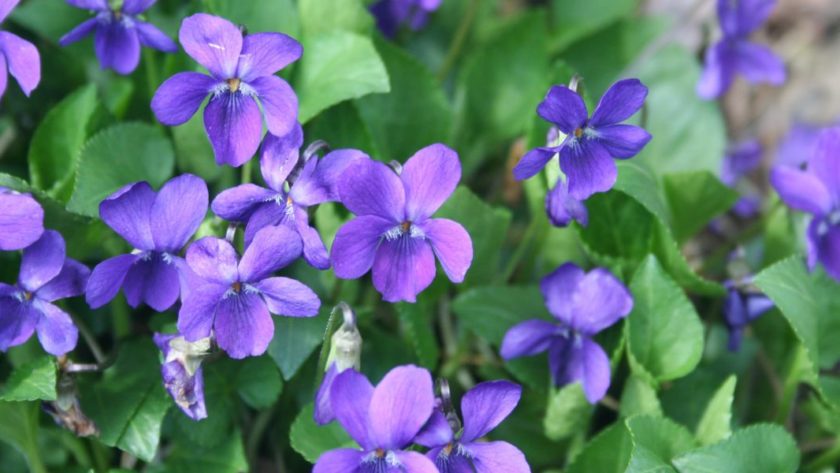
Did you know how important violets are within the LGBTQ community? They hold a deep significance, particularly among lesbian and queer women.
More than just a pretty bloom, the violet symbolises love and affection, and has served as both a romantic motif and a quiet form of resistance.
Sappho’s Poetry
So, how did the violet’s story begin? Its origins as a queer symbol can be traced to ancient Greece, specifically to the poetry of Sappho, a poet from the Greek island of Lesbos in the 6th century BCE. Sappho is widely regarded as one of the earliest and most influential voices to celebrate love between women. In her poetry, she frequently referenced violets as emblems of beauty, love and desire, and women in her verses often wore garlands of violets. This use of violets cemented its early association with lesbian love and femininity.
La Prisonnière
Another moment for the violet as a queer symbol occurred in 1926, with the release of the French play La Prisonnière (or The Captive) by Édouard Bourdet. In the play, a woman sends violets to another woman as a token of romantic affection. The play was considered scandalous for its open portrayal of a same-sex relationship, and there was public outrage. Women who wore violets or purchased them were treated with suspicion, and in some cases, openly harassed. The act of wearing a violet then became a signal of lesbian solidarity.
During this period, violets gained a place alongside other coded symbols used by LGBTQ individuals to signal their identity in secret. Just as gay men in Oscar Wilde’s circle wore green carnations, lesbians began to adopt violets as their own emblem.

The Symbolism of Violets
There’s another reason why the violet is a metaphor for being gay or queer. The flower has a dual nature of being delicate, yet strong and enduring. It often goes unnoticed and thrives in shaded, quiet areas, yet it always blooms despite its environment. The violet represents those individuals that flourish, even in adversity.
In recent years, there has been a growing interest in reclaiming and honouring historical queer symbols, including the violet. As LGBTQ history gains wider recognition, activists have returned to symbols like the violet to show that queer culture began with roots in poetry, literature, and theatre – just like the violet. Some modern LGBTQ art, fashion, and poetry now feature violets as a nod to this legacy.
The violet tells the story of queer women who found ways to exist and express themselves in a difficult world that wasn’t ready for them. Whether in Sappho’s verses, in the hands of women in a 1920s theatre, or on a modern Pride pin, the violet continues to bloom as a testament to LGBTQ resilience and how to live life as your authentic self.