Popular since the 1800s when the orchid craze saw collectors from the UK and Europe bring thousands of exotic species back from rainforests, these beautiful blooms are still loved today for their beauty, elegance and cultural significance.
Rich in history and symbolism, orchids can be found across the world in a variety of climates, from rainforests to deserts. Here are some of the most interesting facts you may not have known about one of the world’s oldest flowers.
They are one of the largest families of flowering plants
Orchids belong to one of the largest flowering plant families, Orchidaceae. In fact, there are around 28,000 known species of orchids, according to The Royal Horticultural Society. But, there could be even more yet to be discovered. The size of the orchid family comes second to the daisy family, aka Asteraceae, which is known to have the most species of any flowering plant family.
They have a unique structure
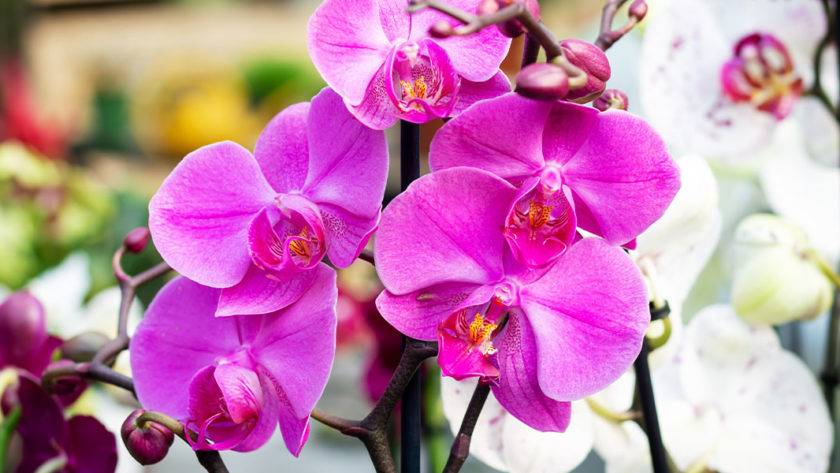
Beautiful orchids have a unique look that’s instantly recognisable. Most orchids are bilaterally symmetrical, so they can be divided into two halves along one axis. They are also upside down – yes, really! Let us explain: Orchids have a lower petal that’s much larger than the others. This is called the lip and it acts as a landing pad for pollinators. But, when the flower is in bud, it’s on the upper side and only when the flower begins to open up, does the stalk rotate so the lip is on the lower side. Genius!
They grow on every continent except one
Orchids are very versatile, growing on almost every continent in the world except Antarctica. From desert-like environments to tropical rainforest, the success of orchids is partly down to their ability to grow practically everywhere! They are a hardy bunch!
They are culturally significant
Like with most flowers and plants, orchids carry their own cultural significance, and the meaning often varies from country to country. In Asia, orchids are a symbolism of beauty and wealth, while in the Aztecs orchids were seen as symbols of power and strength. The word orchid actually comes from the Greek word ‘orkhis’ and they were seen as a symbol of fertility in Ancient Greece where the suggestion was that a man could eat the tubers of certain orchids to boost his sex drive. In Victorian England, in the context of floriography (the language of flowers), orchids were symbols of luxury and wealth, given to someone you love dearly.
Each colour has its own special meaning
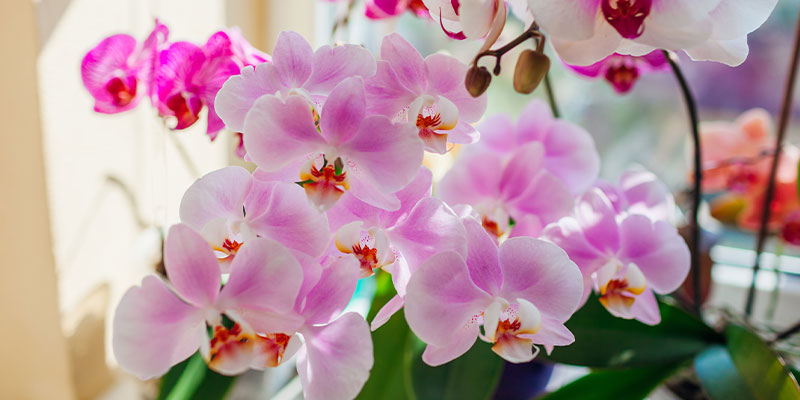
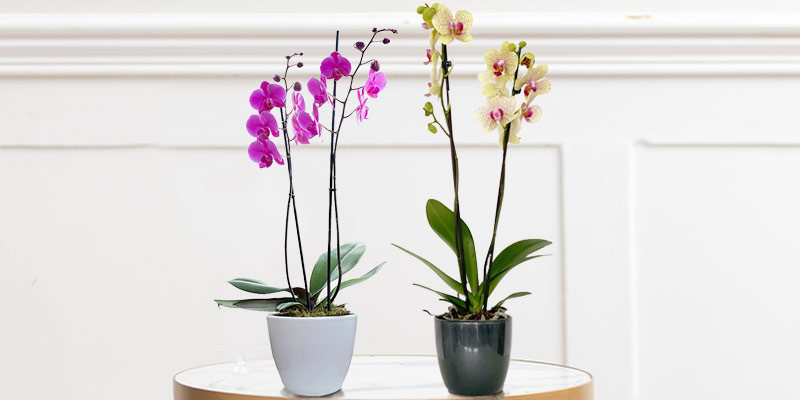
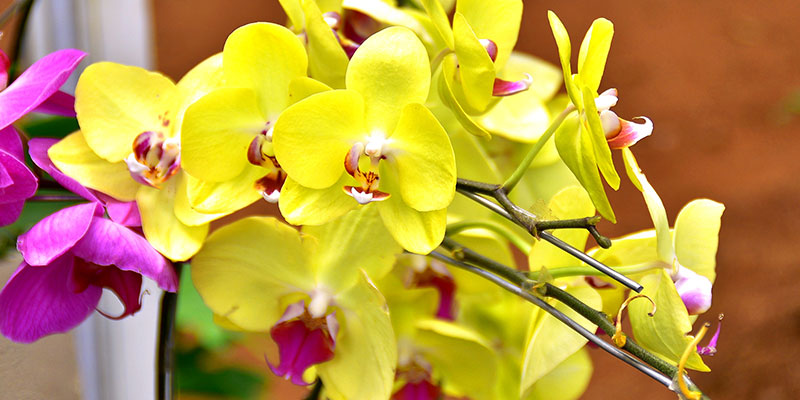
While orchid’s meaning differs from culture to culture, the same is true for different colours. White orchids are typically seen as a symbol of purity and innocence or a sign of new beginnings; purple orchids are symbols of wealth and royalty; pink orchids are a sign of admiration and gratitude; while yellow orchids are often given to friends to convey joy, happiness and well wishes. Like with most red flowers, red orchids are aligned with love and passion; green with luck and blue, which are very rare, are seen as a symbol of uniqueness.
They are popular with pollinators
Different types of orchids have evolved to attract specific pollinators by mimicking the appearance of female insects through a process of pseudocopulation – so clever! The British native bee orchids have slightly furry flowers that give the appearance of a female bee and will lure in male bees who will pollinate the flower. This means that the orchid doesn’t need to produce nectar to attract pollinators, and therefore can save energy.
Vanilla comes from an orchid
Did you know that vanilla flavouring comes from the seedpods of a vanilla orchid? It’s the only type of orchid that produces an edible product, and is loved for its instantly recognisable flavour. Most of the world’s vanilla crop is grown in Madagascar, and used in everything from the perfume industry to baking and cooking.
Brighten up your home or treat a loved one with our beautiful selection of orchid plants, available with next day delivery nationwide.