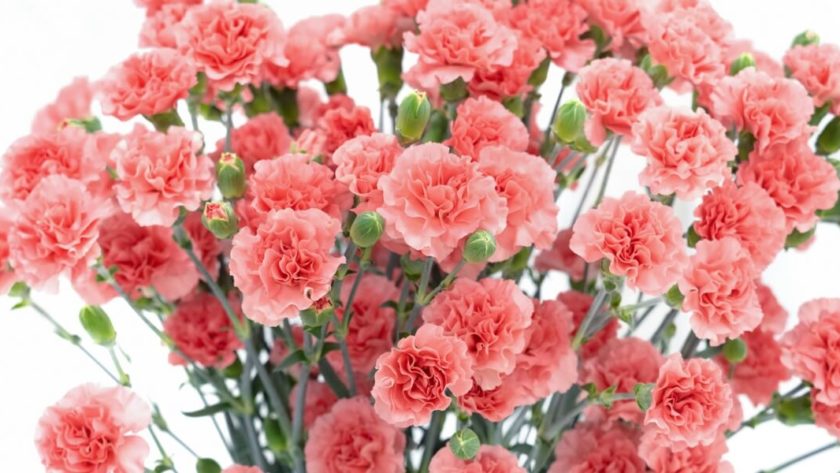
Belonging to the genus dianthus, carnations are one of the most popular and long-standing flowers in the world, having been cultivated for over 2,000 years.
Representing love and admiration, these pretty blooms are widely used in floral arrangements, bouquets and gardens, and are known for their array of vibrant colours and ruffled petals. A beloved flower across cultures and occasions, understanding carnations (from their history and meanings to their different varieties), allows you to truly appreciate one of nature’s most enduring flowers.
The history of carnations
The name ‘carnation’ is thought to come from the Latin word coronatio, meaning ‘garland’ or ‘crown’, as the flowers were often used in ceremonial crowns in ancient Greece and Rome. During the Middle Ages, carnations gained popularity in religious art and were associated with the Virgin Mary, adding to the symbolism of a mother’s eternal love. Over time, their significance evolved through different cultures and eras, and became a staple in Victorian floriography, where each colour conveyed specific emotions. Today, carnations continue to hold historical and cultural importance, particularly as the official flower of Mother’s Day in the US, and the national flower of countries like Spain, Monaco and Slovenia.
The different varieties of carnations
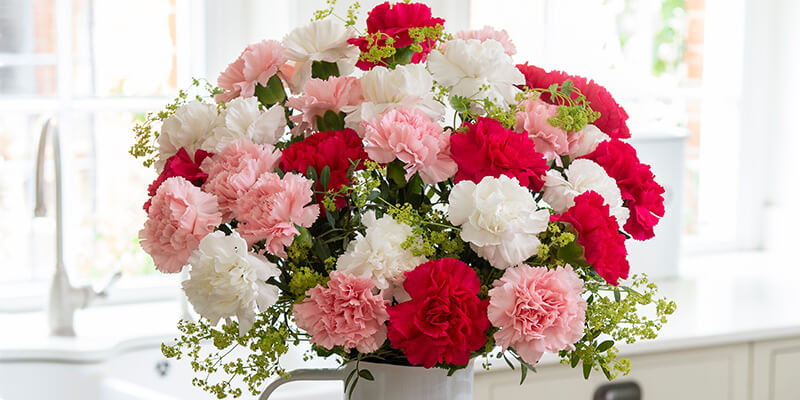
The main types include standard carnations (or large-flowered carnations), which are characterised by a single large bloom per stem, with a wide range of colours and uses. There are also mini carnations (or spray carnations) which feature multiple smaller blooms on each stem. They are commonly used as filler flowers, but are longer-lasting and often more affordable. Dwarf carnations feature smaller blooms and stems, and are often used as garden borders or for bedding.
How long do carnations last?
Their vase life is typically 1-2 weeks, depending on their freshness when cut, water cleanliness, and room temperature, but they can last longer with dedicated care. To make them last longer, trim their stems at a diagonal angle every few days, change the water every two days, and keep them away from direct heat and sunlight. Add cut flower food, remove any lower leaves hanging in the water, and place them away from fruit (fruit emits ethylene gas, which makes flowers wilt faster).
What carnations symbolise
Carnations generally symbolise love and admiration, but they also have colour-specific meanings. Red carnations express deep love and affection, and white carnations symbolise innocence and good luck, whilst yellow carnations can represent disappointment or rejection. Pink carnations are often associated with a mother’s love and gratitude, hence their strong connection to Mother’s Day in the US, but also in the UK.
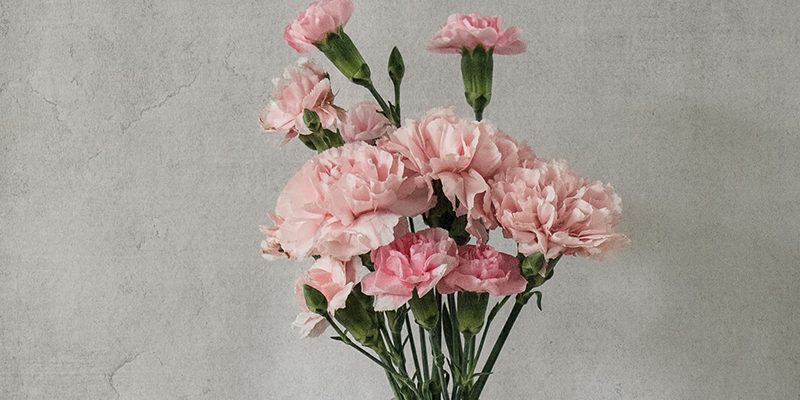
The colours of carnations
As well as red, white, yellow and pink, carnations can also be orange, purple or bi-coloured. The red and white delight carnation (or dianthus caryophyllus) has white petals with red edges, making it a popular choice for gardens and bouquets. Carnations are also one of the easiest flowers to dye due to their absorbent stems. White carnations are often used as the base for dyeing because they absorb the colour.
When do carnations bloom?
Carnations usually bloom from late spring to early summer, but it depends on the variety and growing conditions. Some varieties, like the Malmaison carnations, are known for blooming over a longer period, and can bloom into the autumn months.
Are carnations pet-safe?
No, carnations are toxic to cats and dogs. Ingesting carnations can cause vomiting, diarrhoea and a general upset stomach, so always consult a vet if your pet has eaten carnations.
What do carnations smell like?
Carnations can have a scent that is quite distinctive. Some varieties contain the compound eugenol, which is found in cloves, giving the bloom a clove or nutmeg-like scent. This is strongest in traditional varieties like the dianthus caryophyllus, or pink carnations like the dianthus plumarius and dianthus gratianopolitanus. In Victorian times, it was popular to use the fragrance of carnations in perfumes. However their scent can be more mild or have no fragrance at all in modern florist hybrids, where they’re bred more for their colour and vase life than scent.