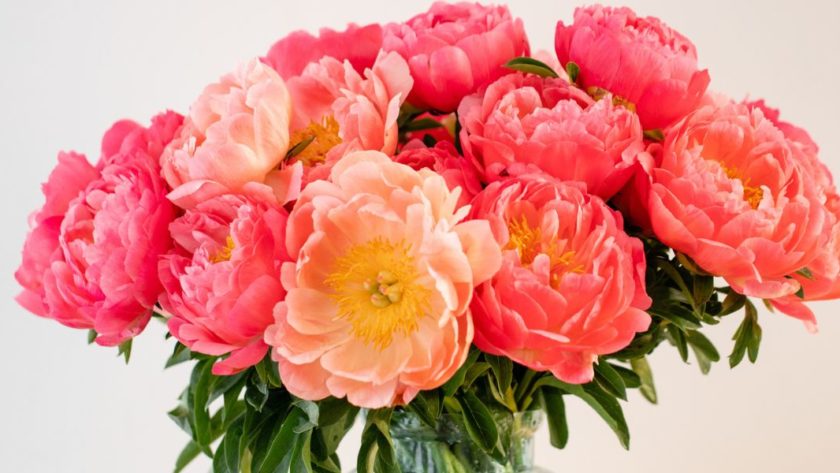
With their delicate petals and beautiful fragrance, plus an incredibly short blooming time, peonies are instantly recognisable and beloved around the globe (they’re grown in Italy, France, the Netherlands, North America and South Africa, to name a few places).
But you’d be forgiven for thinking that peonies are just pretty – when in fact, there’s much more to them than you think.
Overall meaning
Peonies are highly popular in wedding bouquets, as they symbolise love, grace, and joy, as well as being a symbol of inner and outer beauty. They are also the flower for 12 year wedding anniversaries (but your anniversary would have to be between April to June, the peony’s blooming period)!
These blooms are primarily known for their soft pink shade, but they can come in most colours, all of which have different meanings. The popular pink hue means good luck, prosperity and affection, while the white colour means purity and new beginnings. Other colours include red (meaning love, passion, and respect), while yellow peonies signify joy and happiness. You can also get purple peonies, which represent nobility and dignity, and coral peonies, which represent success and abundance.
Peonies in general are often associated with romance, prosperity, and honour across cultures, but they have had different meanings throughout their history…
Rooted in Greek mythology
In Greece today, peonies carry strong symbolism of healing and protection, due to the story behind the name ‘peony’. It comes from ‘Paeon’, who was a student of Asclepius (the Greek god of medicine). Paeon, who was a healer of the gods, used a peony root to treat a wound for Zeus, the king of the gods. Asclepius became so jealous of his student that he threatened to kill him, but Paeon was quickly saved by Zeus, who turned him into a peony flower. Peony roots, seeds and petals were also widely used in ancient Greece to treat a variety of aches and pains.
Embedded in Chinese culture
Today they are known as the ‘king of flowers’, often found in royal gardens, with strong meanings of wealth, nobility, and good fortune. But the peony dates back over 2,000 years in China, with evidence of its cultivation dating back to the Han Dynasty, which began in 206 BCE (meaning ‘Before Common Era’, an alternative to the older term, BC, ‘Before Christ’). It was initially valued more for its medicinal properties, as traditional Chinese medicine used peony root to treat various ailments. But the popularity of peonies spread, and by the Tang Dynasty of 618 – 907 CE (‘Common Era’), peonies had become a symbol of beauty and honour.
Japanese dual symbolism
In Japan the peony has two very different sides. It can represent courage, nobility, and strength, and can be depicted in samurai tattoos alongside lions or dragons. However, peonies can symbolise beauty, grace and good fortune in love too. In this context, peonies are often used in art to reflect an elegant, beautiful woman. They’re often shown throughout history with mythical creatures to highlight their dual symbolism – strength and beauty.
The Victorian era
Because of their large, blushing blooms and the way the petals seem to ‘hide’ their centres, peonies were associated with modesty and bashfulness in Victorian floriography, with a single peony in a bouquet signifying regret or shyness. But even back then they were still popular with brides, as they were also said to signify a happy, prosperous marriage.
Yep, peonies are more than just beautiful blooms. They’re a timeless symbol of love, prosperity, honour, and grace. Whether expressing your love, wishing someone good luck, or celebrating bravery and strength, peonies carry deep, layered meanings that resonate across cultures and centuries.
Treat someone you love or yourself by shopping our beautiful bouquets below!